Vitamin D Deficiency and Musculoskeletal Health
- Vitamin D deficiency is associated with dull, achy musculoskeletal pain that is incompletely responsive to both pharmacologic and manual therapies. The pain may be widespread or confined to a particular area, most commonly the lower back and lumbar spine. The process by which this occurs has been clearly defined: 1) vitamin D deficiency causes a reduction in calcium absorption, 2) production of parathyroid (PTH) hormone is increased to maintain blood calcium levels, 3) PTH results in increased urinary excretion of phosphorus, which leads to hypophosphatemia, 4) insufficient calcium phosphate results in deposition of unmineralized collagen matrix on the endosteal (inside) and periosteal (outside) surface of bones, 5) when the collagen matrix hydrates and swells, it causes pressure on the sensory-innervated periosteum resulting in pain. Indeed, several clinical investigations have recently shown vitamin D deficiency is particularly common among people with musculoskeletal pain.
Non-Musculoskeletal Manifestations of Hypovitaminosis D
- Both the peripheral and central nervous systems have multiple sites of action for vitamin D, and it appears likely that vitamin D modulates serotonin and melatonin synthesis and metabolism. Alterations in vitamin D levels appear to explain, at least in part, the adverse psychological effects of sunlight deprivation that often occur due to geographic location and climate. Preliminary evidence suggests vitamin D deficiency may also be particularly common among patients with inflammatory and autoimmune disorders, and that vitamin D may modulate inflammatory responses.
Bio-D-Mulsion and the Importance of Micro-Emulsification
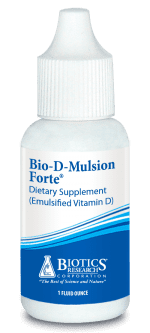
- Biotics Research Corporation’s vitamin D is micro-emulsified to enhance absorption and utilization, which are particularly important for those with malabsorption conditions. Independent clinical experience suggests the micro-emulsion form of vitamin D provides significant improvements in serum levels of 25-OH-vitamin D following supplementation. Each drop of Bio-D-Mulsion supplies 400 IU of vitamin D3, while each drop of Bio-D-Mulsion Forte supplies 2,000 IU of vitamin D3. With an increased knowledge of the importance of maintaining adequate vitamin D levels, many clinicians recommend supplementation and annual screening for 25-OH-vitamin D levels, especially for patients at risk for deficiency as well as those who may benefit from supplementation.
Clinical Details
- Bio-D-Mulsion and Bio-D-Mulsion Forte from Biotics Research Corporation supply vitamin D3 as a micro-emulsion for enhanced absorption and utilization, which is particularly important for those with malabsorption conditions. Bio-D-Mulsion supplies 400 IU of vitamin D3 per drop, while Bio-D-Mulsion Forte supplies 2,000 IU of vitamin D3 per drop. The upper limit of safe intake and physiologic requirements for vitamin D are discussed in the context of recent research and clinical practice.
Vitamin D and Health Implications
- Vitamin D is integral to calcium absorption and bone metabolism. Recent research suggests a broader range of applications for cholecalciferol, and the physiologic requirement may be higher than previously believed.
SKU: 501
UPC: ‘642461609547
Country Of Origin: United States
Manufacturer: Biotics Research